

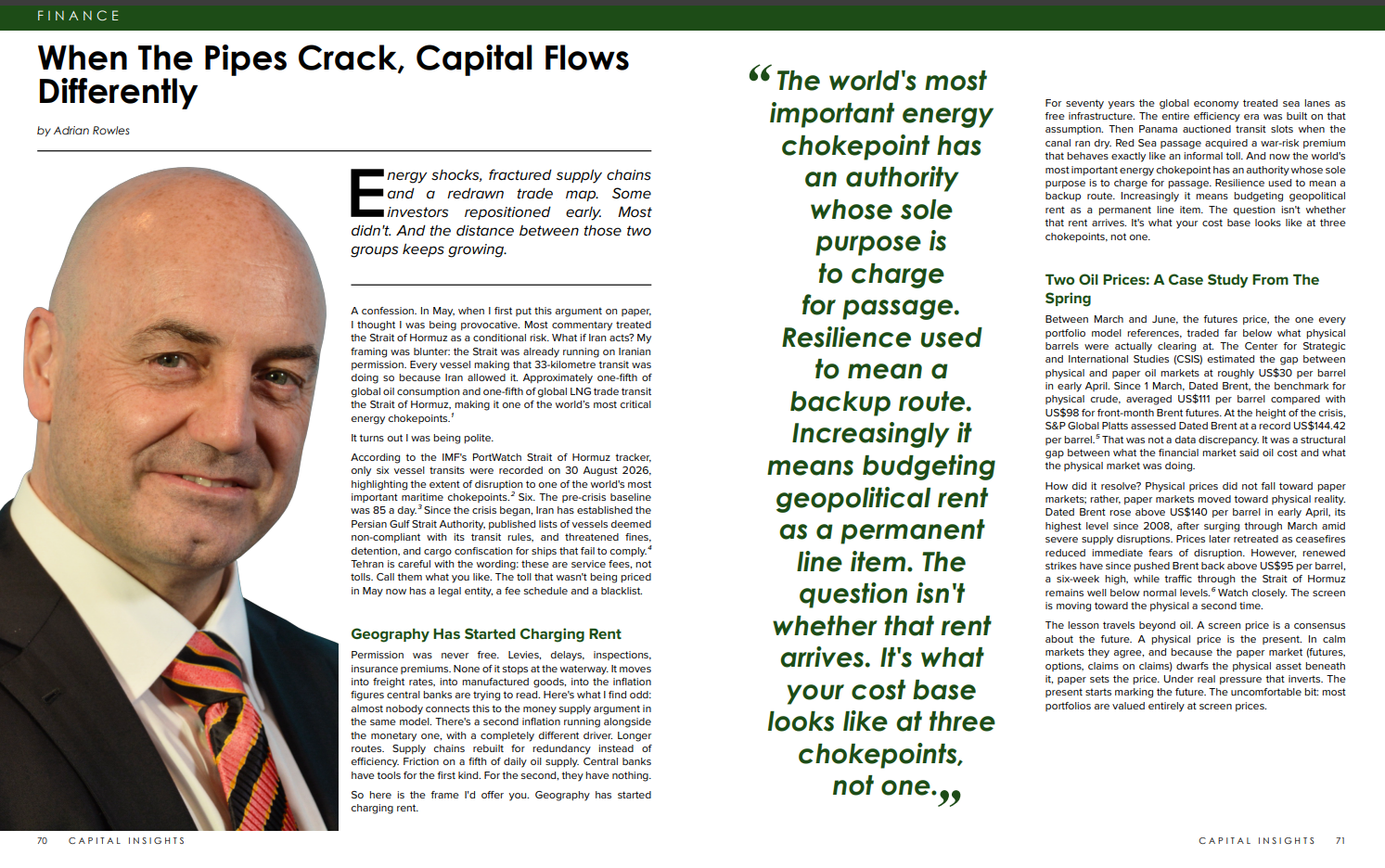
Published in Capital Insights: when the pipes crack, capital flows differently
Capital Club Dubai has published my latest article in Capital Insights, its business magazine, in the Reset & Pivot issue. The issue brings together business leaders and specialists on how to reposition after this year’s regional conflict.
My piece is called “When The Pipes Crack, Capital Flows Differently”. Here’s the argument in brief.
Geography has started charging rent
For seventy years, the global economy treated sea lanes as free infrastructure. That assumption is breaking down.
Panama auctioned canal slots when the water ran low. Red Sea routes picked up a war-risk premium. And the Strait of Hormuz, which carries around a fifth of the world’s oil, now has an authority whose stated purpose is to charge for passage.
Resilience used to mean having a backup route. Increasingly, it means budgeting for these costs as a permanent line item.
A second kind of inflation
Most inflation thinking focuses on money supply. This is a different driver: longer routes, supply chains rebuilt for redundancy rather than efficiency, and friction on energy flows. Central banks have tools for the first kind. For the second, they have very little.
The screen and the barrel
This spring, physical oil traded far above the futures price, the exchange-traded contract price that most portfolio models rely on. Gold shows a similar gap between the price on screen and what physical delivery actually costs. Central banks have been buying the physical metal.
When the two prices disagree, it’s worth asking which one your portfolio is valued on.
Own what you depend on
The clearest example I have is from my own desk. When a leading AI model was suspended this summer under US export controls, my practice kept running. Sensitive work runs on local models on hardware I own, and cloud AI is used only where it earns its place.
That rule came from one principle: own what you depend on, and rent only what you can afford to lose.
Two questions to ask yourself
If your cheapest route closed for six months, which line in your budget would take the hit?
If the defensive part of your portfolio, traditionally the bonds in a 60/40 mix of 60% shares and 40% bonds, hasn’t defended since 2022, what exactly is it insuring?
Read the full article
My piece starts on page 70 of the Reset & Pivot issue: https://qrco.de/CIRP
If you’d like to talk through how these questions apply to your own situation, you can book a call at calendly.com/adrianrowles.