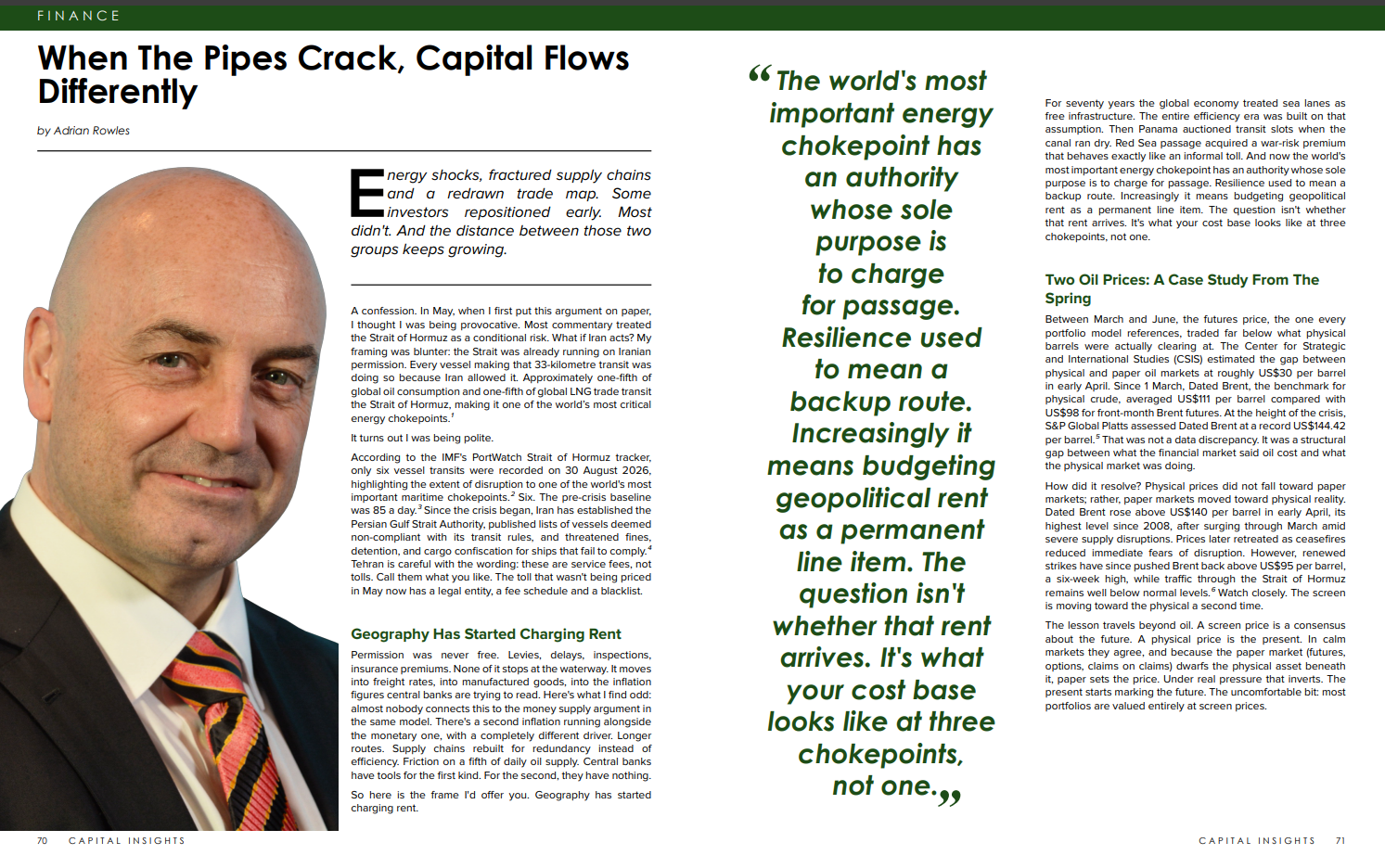
Selected to launch the new 'Meet the Advisers' series for International Adviser, I sit down with Money Map Media to bridge the gap between institutional risk management and private client portfolios. From my background in Japan to navigating the complex cross-border landscape of the GCC, we dive into why transparency and evidence-based investing are more critical than ever in 2026. Watch the full interview and read the feature from Investment International.
The Private Credit Crisis: What Every Investor Needs to Know Right Now Adrian Rowles | March 2026 Something that rarely happens in financial markets has just happened five times in ten days. BlackRock. Blackstone. Morgan Stanley. Cliffwater. Ares. Five of the world's largest investment platforms have all restricted investor withdrawals from their private credit funds — simultaneously. Over $265 billion in market cap has been erased from the major private credit managers since September 2025. Default rates hit a record 9.2% in 2025. Brent crude closed at $103 on March 14. Rate cuts are off the table. And floating-rate private credit borrowers — already at record stress — now face higher energy costs and higher interest bills at the same time. Mohamed El-Erian compared this moment to August 2007. George Noble called it "a financial crisis unfolding in real time." If you hold a private credit fund with quarterly redemptions, this is the time to get informed. Read the full report →
He lost $20,000. I turned $9,600 into $15,549. Same markets. Same year. The difference wasn't luck or timing - it was the risk framework sitting behind every single trade. Here's the full story, including the numbers, the costs, and why the fee argument is completely upside down.
In January 2026, BlackRock marked down its private credit fund by 19%. That wasn't a technical adjustment. It was a billion dollars, gone, formally acknowledged - and the people tracking this space closely weren't surprised. Here's what the data actually shows, and what investors holding BDCs, private debt funds, or CLOs should be doing right now.
AI is quietly triggering one of the most powerful – and least understood – supercycles in global markets: the PC memory squeeze. DRAM prices are up triple digits year-on-year, NAND costs are spiking, and suddenly the “cheap, commoditised” memory everyone ignored has become the profit engine of the semiconductor world.– this is the briefing to read before you reposition your portfolio.
AI & the new architecture of power. From Sci-Fi to Balance Sheet: Nuclear and Geothermal Get Real: Small Modular Reactors (SMRs) and Enhanced Geothermal Systems (EGS). The investment implication is that the risk/return profile for these once-fringe technologies has been fundamentally altered. AI's non-negotiable demand for reliable, grid-independent power has transformed them from venture-style bets into core infrastructure necessities, creating a new, defensible asset class for long-term capital. The artificial intelligence boom is in full force, and for the last two years, investor attention has been laser-focused on the semiconductor arms race. But as the world’s largest technology companies race to build out their AI capabilities, a less-discussed, more fundamental crisis is emerging: the monumental power shortage required to fuel this revolution.
The week beginning 25th August 2025 saw stocks mixed on wall street, despite a rally on Friday due to short-term interest rate flexiblity.
Looking to ensure a strong portfolio geared towards long-term growth in this age of AI? We offer specialised and experienced advice to drive and future-proof your wealth. Explore the major trends and opportunities in power, connectivity, and sustainable investing shaping wealth strategies for expats, HNWIs, and forward-thinking investors. Get actionable insights into the companies and sectors redefining next-generation wealth in the AI era. #AIinfrastructure #InvestorInsights
🚨 UK House Value Tax Proposal: What Property Investors Need to Know. While the 2025 Autumn Budget is expected in late October/early November 2025, the House Value Tax implementation would most likely begin in April 2026 if announced. This timeline would provide approximately 5-6 months for legislative passage, system preparation, and market adjustment following any Budget announcement.