

The Private Credit Crisis: March 2026 - What Every Investor Needs to Know
The Private Credit Crisis: What Every Investor Needs to Know Right Now
Published March 2026 | Adrian Rowles, Financial Adviser

I had a call last Tuesday with a client in Abu Dhabi who holds about 40 percent of his liquid net worth in two private credit funds. He opened with: "Adrian, should I be worried about this Blackstone thing?" And I realised halfway through my answer that I was not giving him the short version he wanted. Because there is no short version of this. Not anymore.
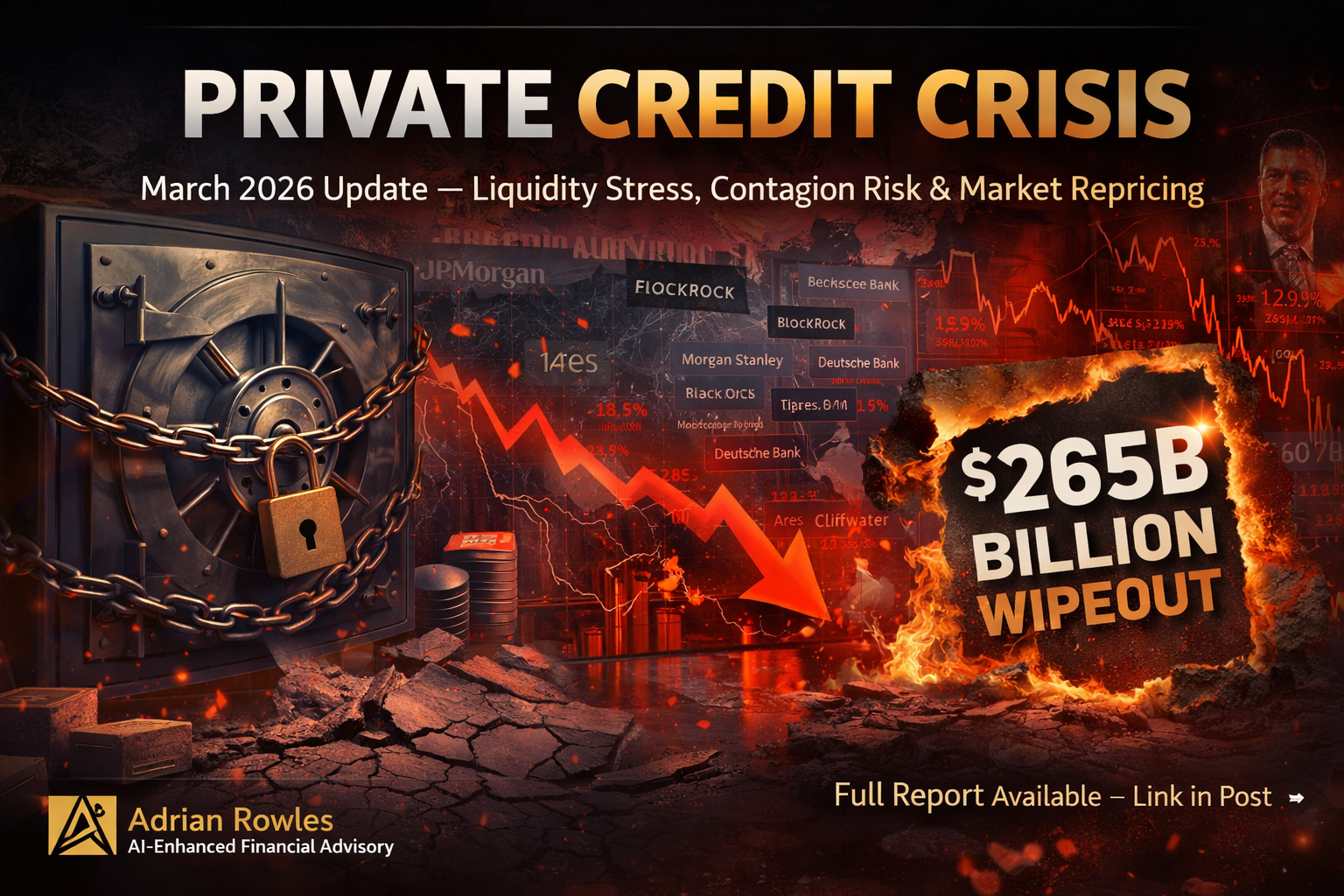
Something that almost never happens in financial markets just happened five times in ten days. BlackRock, Blackstone, Morgan Stanley, Cliffwater, Ares. All of them have restricted or outright blocked investor withdrawals from their private credit funds within a single week of each other.
That is not a coincidence. That is a cascade. And it changes the conversation about private credit entirely.
I Need to Back Up a Bit
For the past several years, private credit has been the easy sell across the wealth management industry in the Gulf and Asia. Steady 8 to 10 percent annual income. Low drawdowns compared to equities. Quarterly exit windows if you ever need your money back. I have been in the room when those pitch decks go up on the screen. Polished slides, clean track records, and the implied promise that you are getting hedge fund returns with bond fund stability.
And look, in fairness, the numbers did work for a while. When rates were low and credit spreads were tight, the underlying maths held together. I told clients that. I was not sitting in the corner shaking my head the entire time. Some of these vehicles genuinely delivered what they promised through 2022 and 2023.
The problem is that the environment has changed and the product has not adapted to it. That gap is now showing up in the most dramatic way possible.
The Numbers People Are Not Talking About Enough
Default rates across private credit portfolios hit 9.2 percent in 2025. I want to stay on that number for a second because it tends to get buried in the broader headlines. 9.2 percent is higher than the comparable default rates during the 2008 financial crisis. Not close to 2008. Higher than 2008.
Over 265 billion dollars in market cap has been wiped from the major private credit managers since September 2025. That is not a gentle repricing or a temporary sentiment wobble. The market is repricing the entire business model.
And then oil happened.
Brent crude closed at 103 dollars on March 14. WTI at 99.31. That is oil up more than 58 percent in a single month because of the Strait of Hormuz blockade, and it has basically removed any remaining hope of rate cuts from the 2026 calendar. The Fed cannot cut into an energy shock. Everyone in the market knows that now.
So here is what that means practically. The borrowers inside these private credit portfolios are mostly floating-rate. They were already at record stress levels before the oil move. Now they are facing higher energy costs and higher interest costs at the same time, with no relief coming. That is not a headwind. That is a compounding stress loop, and it is the kind of environment where defaults do not just drift higher. They accelerate.
Five Gates in One Week
Alright, the redemption gates. This is the part I have spent the most time explaining to clients recently, because it is genuinely unusual and I think the significance is being underestimated.
When a fund restricts withdrawals, what they are telling you is that they cannot meet redemption requests without selling assets at distressed prices. One fund doing that is a specific problem. Could be a concentration issue, could be a bad loan book in one sector. Isolated. Manageable. Fine.
Five of the largest credit platforms in the world doing it in the same week is not isolated. It is systemic. And the names involved here are not small shops or niche credit players. These are the institutions that are supposed to be best in class at managing exactly this kind of risk. If BlackRock and Blackstone cannot provide liquidity to their investors right now, that tells you something about the asset class itself.
Mohamed El-Erian compared this to August 2007. That was when BNP Paribas froze redemptions on three structured credit funds, and we all know what followed six months later. George Noble, the former Fidelity fund manager, has called it a financial crisis unfolding in real time.
Am I saying this is 2008? No. I genuinely do not know, and neither does anyone else. What I am saying is that the pattern is familiar enough to warrant serious attention from anyone with capital in these structures. The sequencing is uncomfortable. Ignore it if you want. I would not.
Why I Am Writing This Specifically for My Client Base
Private credit has been heavily distributed through the advisory and wealth management channels that serve the GCC and Asian expat markets. That is my world. A lot of people I work with hold these instruments. Some of them hold them as a significant chunk of their investable wealth because the quarterly income story was exactly what they were looking for when they moved to the UAE or Japan and wanted something stable to park capital in.
I spoke with a couple in Dubai Marina a few weeks ago. Both working professionals, dual income, no kids, sensible people. About 35 percent of their portfolio was in a private credit vehicle that promised quarterly liquidity and a stable NAV. They had never once asked what the underlying default rate was. Not because they are careless. Because the quarterly statements looked fine. The income arrived on time. The pitch deck said low correlation and downside protection. Why would you dig deeper when everything appears to be working?
That is the trap. And it is a trap that catches smart people specifically because the product is designed to look boring and safe right up until the moment it is not.
If you are holding one of these vehicles, the questions you need to be asking are quite specific. What is the underlying default rate in the portfolio right now? How concentrated is the book in sectors exposed to the rate and energy squeeze? What are the gating provisions in the fund documents, and has the manager exercised them before? What does their own stress testing show if defaults go from 9 to 12 or 13 percent?
If your adviser cannot walk you through those answers in plain language, that is a separate conversation worth having.
>> The Full Report
I have been tracking this for months and briefing clients as the situation has developed. The detailed report covers every manager involved, every redemption gate, the JPMorgan collateral markdown, Deutsche Bank's 30 billion dollar exposure disclosure, the connection between AI-software sector defaults and broader credit contagion, and what it all means for recession probability over the next 12 to 18 months.
It is not light reading. I am not going to pretend it is. But if you have meaningful exposure to private credit, or you are being pitched a new allocation, this is the kind of analysis that should be sitting next to whatever product brochure your adviser has given you.

[DOWNLOAD THE FULL REPORT HERE]
Private Credit Crisis March 2026 Update AR.pdf

What I Am Telling Clients Right Now
I am not telling anyone to panic or dump everything into cash. That is not how you manage serious capital and frankly that kind of reactive decision-making is usually where the real damage gets done.
What I am telling clients is this. Get clarity on your actual exposure. Not the headline number on the statement. The underlying credit quality, the sector tilt, and the gating provisions in the fine print. If you have been holding these positions without reviewing the fund documents recently, now is the time.
If you are considering a new allocation to private credit, understand that the risk profile has shifted materially from what you were shown six or twelve months ago. The sales pitch may not have caught up to the reality yet. It usually does not until it is too late to matter.
And if you want to work through the detail of this with someone who has been following the situation closely, understands how institutional credit risk behaves under stress, and can actually read a loan book rather than just a marketing factsheet, I am available.

Book a confidential call:
calendly.com/adrianrowles
Email: adrian@arFinancialAdvisor.com

Adrian Rowles is a financial adviser based in Dubai Marina, operating under AR Financial Advisor and Acuma. He serves individuals, businesses, corporates and family offices across the UAE, Japan and international markets, combining institutional-level training from former Goldman Sachs, Bank of America and Commerzbank hedge fund practitioners with AI-enhanced advisory capabilities.