

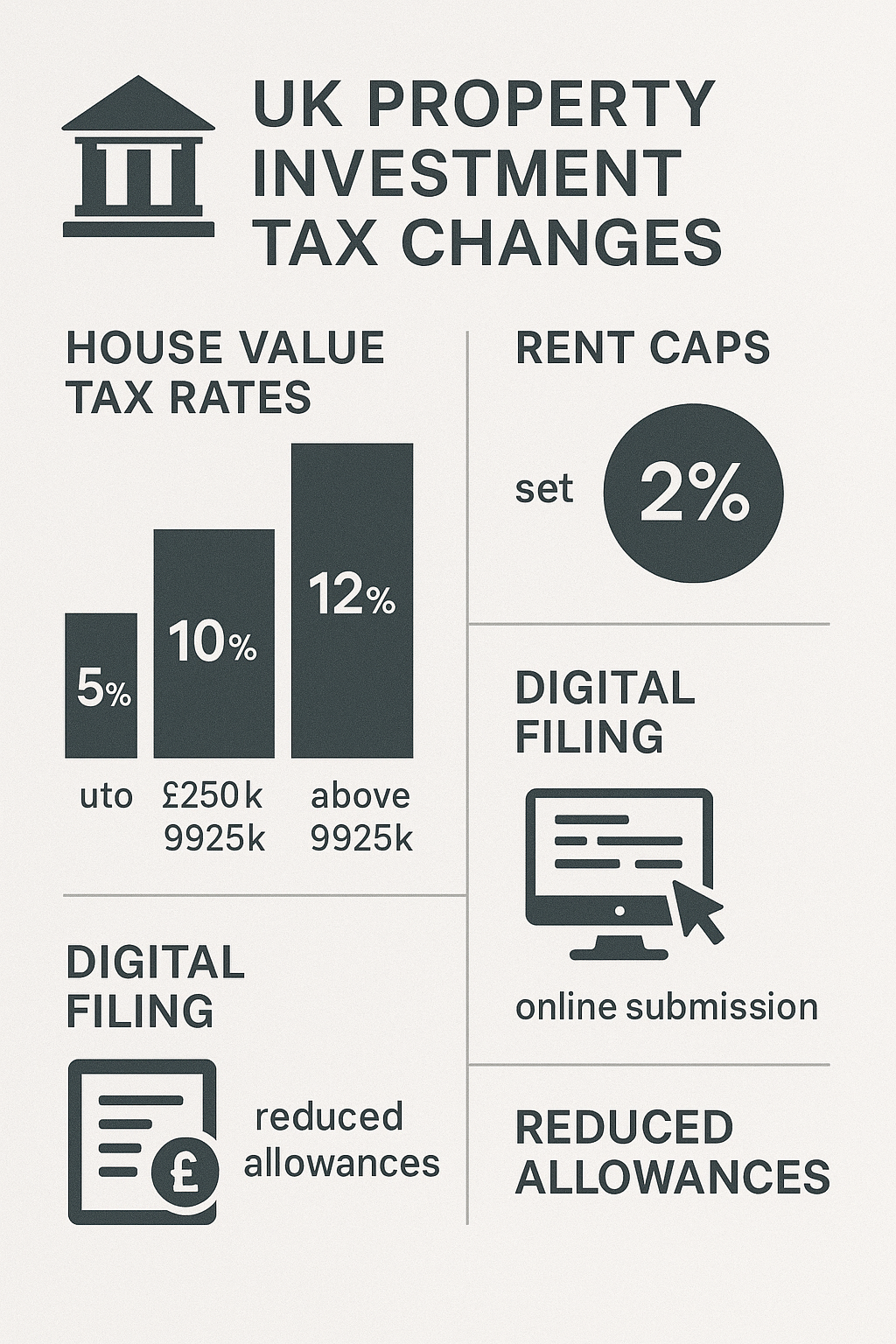
UK Property Investors Getting Absolutely Hammered - Full Breakdown of What's Coming
A property investor based in London recently raised a straightforward concern during a portfolio review:
“With everything changing, is UK property still worth holding?”
It is a reasonable question. The challenge is that there is no longer a short answer.
Because what is currently unfolding in the UK property market is not a single policy shift. It is a coordinated set of changes affecting taxation, rental income, compliance, and ownership structures simultaneously. Most commentary has focused on one element, usually the proposed House Value Tax. That misses the broader picture entirely.
This is not one change. It is a stack.
The Setup Is Changing Faster Than Most Realise
For years, UK property, particularly buy-to-let and furnished holiday lets, has been positioned as a relatively stable, income-generating asset class. Leverage worked. Tax treatment was manageable. Rental growth broadly kept pace with inflation. Administrative friction was tolerable.
That framework is now being rewritten.
Several policy shifts, each meaningful on its own, are being introduced in close succession. Together, they materially alter the risk-return profile of property investment, especially in London and the South East.
🏠 The House Value Tax (The Big One)
The headline change is the proposed annual tax on higher-value properties, expected to take effect from April 2026 (likely):
Properties over £500k get hit with annual tax
0.54% on values £500k-£1m
0.81% on values above £1m
Sellers pay it, not buyers
BTL stamp duty stays the same (because why would they help landlords?)
The structural change here is not just the rate. It is the move from a one-off transaction tax to a recurring annual cost.
A £750,000 property, for example, would incur approximately £1,350 per year under this model. That replaces part of the upfront stamp duty burden but introduces a permanent drag on holding costs.
Example: £750k London property = £1,350/year vs current one-off stamp duty of £37,500
Only around 20 percent of transactions would fall into scope, compared to roughly 60 percent under the current stamp duty regime. The impact, however, is heavily concentrated in London, where average property values already sit above the threshold.
💸 Allowances Getting Binned
The removal of Furnished Holiday Let (FHL) benefits from April 2025 is a more immediate and, for many investors, more damaging shift.
Furnished Holiday Lets (FHLs) - RIP April 2025:
No more capital allowances on furniture/equipment
Mortgage interest relief capped at 20% (basic rate only)
All the sweet CGT reliefs gone (Business Asset Disposal, Rollover Relief, etc.)
Basically turned FHLs from tax-efficient to tax-inefficient overnight
The net effect is straightforward. A structure that was previously tax-efficient becomes materially less so, almost overnight. Alongside this:
Personal allowances frozen (real-terms tax rise)
CGT annual exemption stuck at £6k (was £12.3k in 2022)
Non-resident buyer surcharges unchanged (still getting rinsed)
Individually manageable. Collectively significant.
Rent Caps and Income Compression
Rental income, historically the stabilising component of property portfolios, is now facing direct constraints.
🏘️ Rent Caps (The Landlord Killer)
New nationwide rules through Feb 2026:
Rent increases capped at 2% per year OR CPI inflation (whichever is lower)
Extended rental review intervals in "Rent Pressure Zones"
With inflation running higher, this is basically a real-terms rent cut
In an environment where inflation is running higher than 2 percent, this effectively results in a real-terms reduction in rental income.
At the same time, costs, financing, maintenance, and compliance are not subject to the same cap.
That gap matters.
💻 Digital Filing (Because Paperwork Wasn't Fun Enough)
Making Tax Digital for Property (April 2026):
All property income must be filed digitally
Regular reporting requirements
Better get friendly with accounting software
More admin = more costs
This is not a headline-grabbing change, but it adds friction. More administration, higher compliance costs, and less flexibility for smaller landlords operating informally.
🏢 Corporate Structure Benefits (The Only Good News?)
One area where the framework remains relatively intact is within corporate ownership structures.
If you're incorporated:
Still get full mortgage interest relief
19% corp tax on profits up to £250k, 25% above
Joint spouse ownership rules enforced (50:50 split unless you elect otherwise)
As personal ownership becomes less efficient, incorporation starts to look less like an optimisation and more like a requirement for certain portfolios.
📊 The Numbers That Matter
Geographic impact:
UK average house price: £272k (most unaffected by House Value Tax)
London average: £550k-£667k (completely screwed)
Only ~20% of sales hit by new tax vs 60% with current stamp duty
Property, particularly higher-value property, becomes an obvious target.
This is less about housing policy and more about revenue strategy.
Revenue context:
Government has £50bn black hole
Property wealth concentrated in London/South East
Labour can't touch income tax/VAT/NI per manifesto
🎯 What This Actually Means
For BTL investors:
Higher carrying costs on expensive properties
Rent increases limited while costs rising
FHL strategy completely dead
More admin burden
London/South East particularly targeted
Market effects:
Potential ceiling at £500k (nobody wants to cross that threshold)
Seller-pays model changes transaction dynamics
Geographic arbitrage opportunities outside London/South East
Corporate ownership suddenly more attractive
The behavioural shift is as important as the financial one.
🔍 Timeline to Watch
October/November 2025: Autumn Budget (decision time)
April 2025: FHL changes take effect
April 2026: House Value Tax + Digital filing starts
Feb 2026: Current rent cap rules expire (may be extended)
This creates a relatively narrow window for repositioning before the full framework is in place.
📚 Resources to Monitor
Official sources:
HM Treasury
HMRC
Onward Think Tank report (the blueprint for House Value Tax)
Industry:
Propertymark
UK Finance
💭 Discussion Questions
Anyone else modeling the combined impact of all these changes?
Is corporate ownership now the only viable structure for serious investors?
Geographic diversification strategies - where are people looking?
How are you handling the FHL transition if affected?
Rent cap compliance - what systems are people putting in place?
🎯 My Take
This feels like the most coordinated attack on property investment we've seen. The government is essentially saying "we need revenue and property wealth is where we're getting it."
The combination of:
Annual wealth tax on high-value properties
Restricted rental income growth
Reduced tax efficiencies
Increased admin burden
Geographic concentration of impact
...suggests they want to cool the London/South East property market while generating revenue from wealth holders.
Strategic implications:
Portfolio reviews urgent for anyone with £500k+ properties
Geographic diversification suddenly critical
Corporate structures need evaluation
Cash flow modeling essential with rent caps + new taxes
5-6 month window to reposition if House Value Tax announced
Disclaimer: Not financial advice, this is just my analysis of publicly available information. Do your own research, speak to professionals, etc.